Seeing What ChangedTransition-Guided Credit Assignment
for GUI Agents
A successful task does not mean every action deserves credit. OTAD uses what changed on screen to assign the verified outcome more precisely across turns.
The outcome says
whether it worked. The screen
shows what changed.
Trajectory-level training broadcasts the same advantage across every turn. A mistaken click, its correction, and the decisive action can all be reinforced equally. Before-and-after screenshots offer finer evidence.
The verifier determines the sign of the advantage; observable state changes determine each turn’s weight. The scorer is used only during training.
Align every update
with visible evidence.
Observable-Transition Advantage Decomposition (OTAD) makes hindsight ordinal judgments about screenshot changes, then maps them to non-negative weights on the trajectory-level advantage rather than adding new rewards.
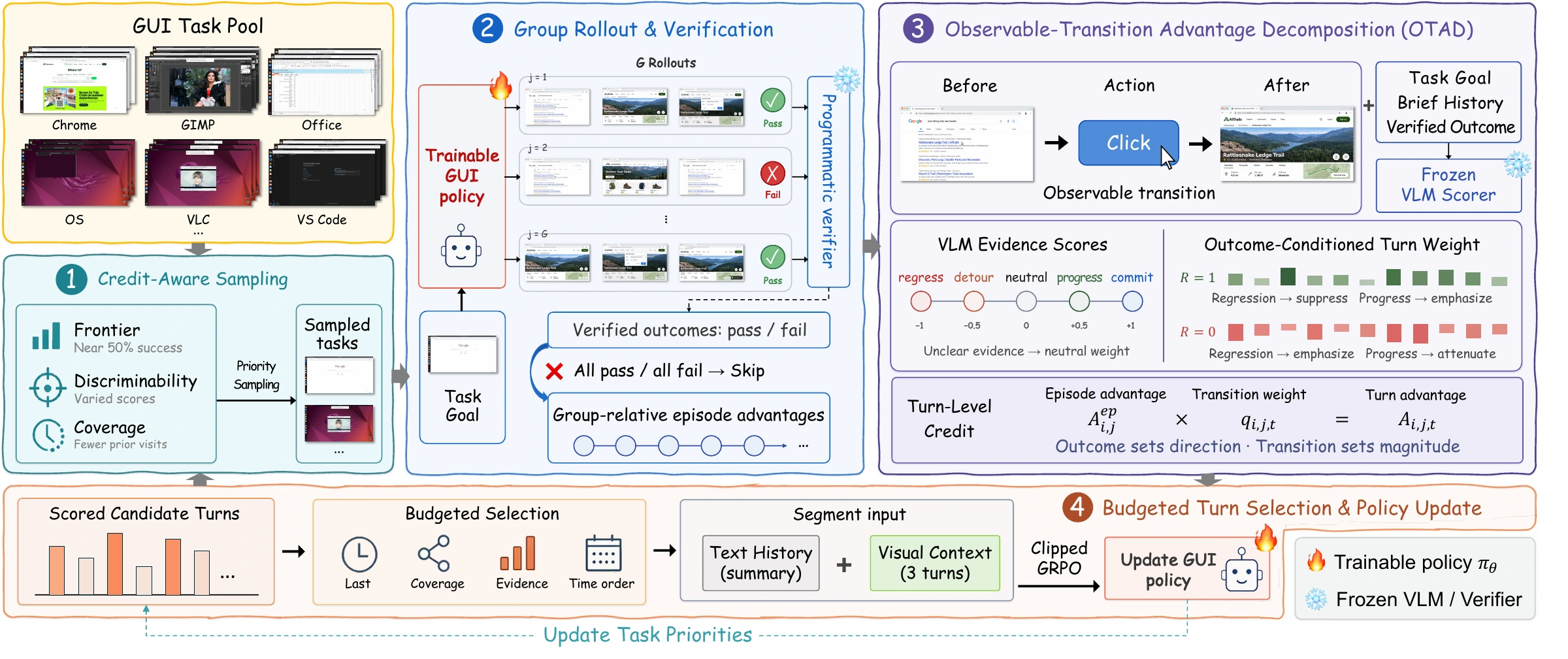
Observe the change
Compare screenshots before and after each action, conditioned on the goal, context, and verified outcome.
Allocate advantage
The verifier fixes the sign. Non-negative transition weights change only its magnitude, allowing detours in successful runs to be downweighted.
Spend the budget well
The same evidence selects informative training turns and prioritizes tasks near the capability frontier.
Sharper credit assignment.
Higher task success.
Across 361 evaluated OSWorld-Verified tasks, OTAD and budget-matched GRPO share the same SFT starting point, 50-step interaction cap, and training budget. Success rates are means over three independent passes.
overall success for OTAD-Qwen3-VL-8B
Same 8B backbone; 50 interaction steps per trajectory and at most 16 selected training turns per trajectory.
Across task categories
OTAD · success rateSingle-turn GUI grounding
AccuracySource: Tables 1, 2, and 3 of the paper. OSWorld-Verified covers 361 eligible tasks; results are means over three passes, with ±1.0 standard deviation for OTAD overall. Scorer compute is not matched in the GRPO baseline; see the paper.
Watch the work unfold.
These four cases come from the provided evaluation records. Both the result file and trajectory metadata mark each run as successful. Watch the original recording or inspect screenshots and action logs turn by turn.
From a change on screen
to a better policy update.
Read the method, experimental setup, full comparisons, and theoretical appendix.
Open paper PDFCite this work
This manuscript is under anonymous review. Please use the final author and publication details when the paper becomes public.
@misc{otad2026,
  title  = {Seeing What Changed: Transition-Guided Credit Assignment for GUI Agents},
  author = {{Anonymous Authors}},
  year   = {2026},
  note   = {Manuscript under review at ICLR 2027}
}
Provisional citation: authors, publication year, and public link will be updated after release.